100-inch TVs: who are they best for?
By Philips
21/08/2026
5-8 min. read

A 100-inch TV is the sort of thing that makes people stop mid-sentence when they see it. It is enormous, slightly absurd and very impressive. Getting one into your home can feel like a group project involving careful angles, open doors and a bit of faith, but once it is in place, it has real wow factor. This is not a TV for everyone. It is for people who want their living room to make a statement.
At a glance
- How big is a 100-inch TV?
- How heavy is a 100-inch TV?
- Where does a 100-inch TV make sense?
- How far should you sit from a 100-inch TV?
- Is a 100-inch TV too big?
- Should you choose 85 or 100 inches?
- Does Ambilight make a difference on a 100-inch TV?
- Bottom line
How big is a 100-inch TV?
A 100-inch TV measures the screen diagonally, not across the width. In real terms, it is about:
- 254 cm diagonally
- 221 cm wide
- 125 cm high
That is excluding the stand, bezel or any extra depth from the cabinet design.
You may also come across 98-inch TVs when looking in this part of the market. In practice, they sit in very similar territory. The room-planning advice is much the same.
How heavy is a 100-inch TV?
A 100-inch Philips TV is around 46 kg without stand, and around 47 kg with it. That means you need to look seriously at stand width, total weight, wall strength and cable planning before installation day.
- it is not a casual one-person setup
- if you keep it on a stand, the stand or unit needs to be sturdy enough for the size and weight
- if you wall-mount it, the wall strength matters every bit as much as the bracket
It is also worth thinking beyond the bracket or stand. Getting it through the door is its own challenge. With a TV this size, you may need more than one pair of hands and a quick reality check on doorways, stairs and lifts.
Where does a 100-inch TV make sense?
A 100-inch TV is usually a good fit for:
- very large living rooms
- open-plan spaces with generous viewing distance
- dedicated media rooms
- home cinema-style setups
It can work brilliantly as a main TV, but only if the room has real scale. In an average living room, a 100-inch screen can cross the line from immersive to overwhelming very quickly. This is not usually the size you buy because it happens to fit. It is the size you choose because the whole room is built to support it.

How far should you sit from a 100-inch TV?
For most 4K setups, a 100-inch TV usually starts to make sense from around 3 metres. A practical range is roughly 3 to 4 metres, depending on how immersive you want the picture to feel. That keeps it in the territory where the screen feels cinematic rather than relentless.
If you sit much closer than that, everyday viewing can start to feel demanding. If you sit much further back, a 100-inch TV can still look impressive, but the whole point of going this large is to let the picture take over in a controlled, comfortable way.
Is a 100-inch TV too big?
Sometimes, yes. A 100-inch TV can look spectacular, but it is not automatically the right answer just because bigger screens tend to feel more immersive. If the room is tight, the seating is too close or the screen dominates everything around it, it can feel tiring rather than luxurious.
In the right room, though, 100 inches can feel genuinely transformative. It is the sort of size that turns sport into a gathering, games into a full-room experience and films into the centre of the evening.
Should you choose 85 or 100 inches?
A 100-inch TV has about 38% more screen area than an 85-inch model. That is not a small step up. It is a leap.
- 85 inch: already cinematic, easier to place, and more realistic for a wider range of large rooms
- 100 inch: more dramatic, more demanding, and best reserved for spaces that can properly absorb its scale
If your seating position is around 3 metres or more and the room has the width, wall strength and breathing space to carry it, 100 inch is the size that starts to feel genuinely revolutionary at home. If the room is merely large rather than truly generous, 85 inch is often the more sensible choice.
What is the best TV size for you?
Choosing a new TV size? Read this article and find the best TV size for your room & viewing distance.

Does Ambilight make a difference on a 100-inch TV?
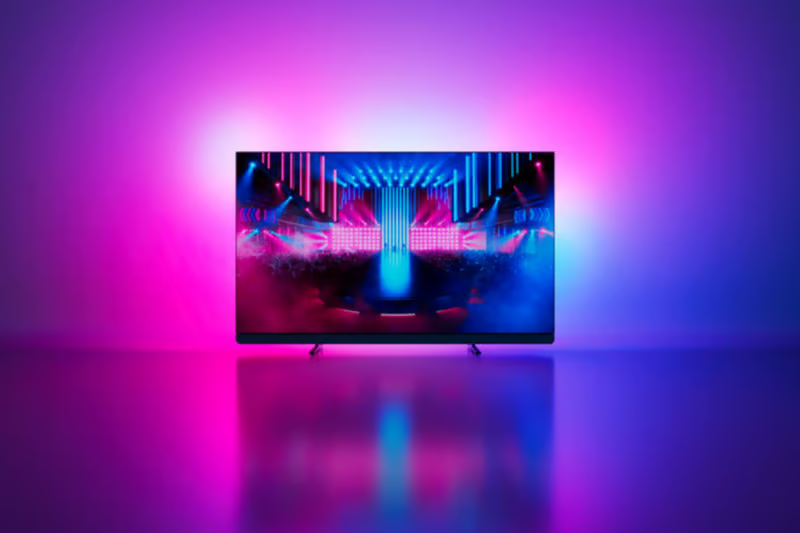
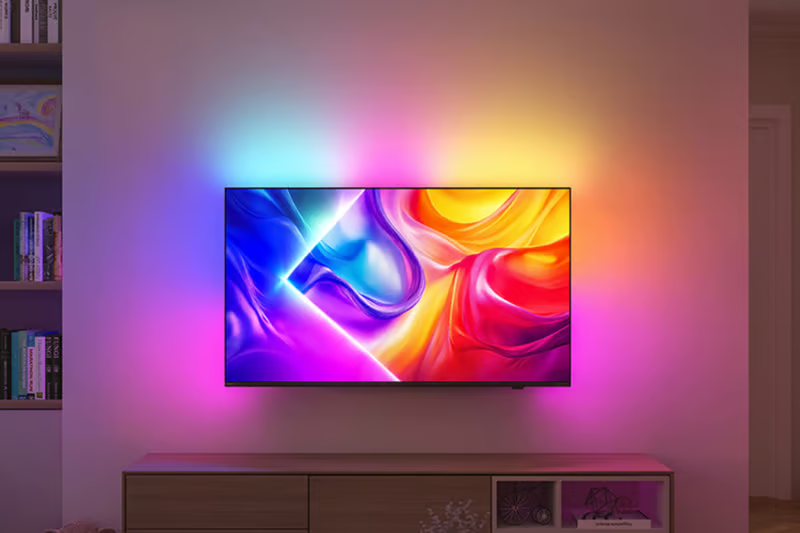
Yes. On a 100-inch TV, Ambilight adds something sheer size alone cannot quite deliver: atmosphere. A late-night film feels more expansive, live sport picks up extra energy, and the whole setup takes on that rare sense of presence people are usually chasing when they move into truly large-screen territory. It is not just a bigger picture. It is a room that feels more caught up in what is on screen.

Bottom line
A 100-inch TV is a serious screen for serious spaces. It works well if:
- you sit around 3 to 4 metres away
- you have the wall space, furniture and installation conditions to support it properly
- you want a setup that feels closer to a home cinema than a conventional living-room TV
But if the room is smaller, the seating is closer or the screen would overpower the space, it is usually better to step down a size. At 100 inches, the magic comes from the fit, not just the number.
This article was created with the assistance of AI, along with detailed input, careful editing, and fact-checking by our team to ensure accuracy and quality.
Recommended products
New
77OLED761/05- 194cm(77") Ambilight TV, AmbiScape
- 4K OLED. 120 Hz
- P5 AI Intelligent Engine
- IntelliSound
New
65OLED761/05- 164cm(65") Ambilight TV, AmbiScape
- 4K OLED. 120 Hz
- P5 AI Intelligent Engine
- IntelliSound
New
65MLED901/12- AMBILIGHT TV, AmbiScape
- 4K MiniLED. Up to 144Hz
- P5 Perfect Picture Engine
- IntelliSound
New
85MLED981/12- Ambilight TV, AmbiScape
- 4K RGB MiniLED. Up to 330Hz DLG
- P5 AI Intelligent Engine
- IntelliSound


You might like

What is the best screen size for you?
Reading time: 8-14 min.

How to place your TV right in any room
Reading time: 12-14 min.

What makes a TV good for gaming?
Reading time: 6-8 min.

What is Titan OS?
Reading time: 4-6 min.

What is Ambilight TV? Why should you have one?
Reading time: 6-8 min.

What is Quantum Dot?
Reading time: 4-6 min.