What is the best TV size for you?
By Philips
14/08/2026
8-14 min. read

Choosing the right TV size can change how natural and comfortable your experience will be. Go too small and films, sport and games can feel underwhelming. Go too big for the space and the screen can take over in a way that does not feel comfortable.
The decision usually gets much easier once you look at three things: your viewing distance, your room layout and how you actually watch day to day. This guide covers the basics, shows how TV sizes translate into real dimensions and gives practical recommendations for different rooms so it is easier to choose with confidence.
At a glance
- TV size basics: diagonal vs actual dimensions
- Room-based recommendations: the best TV size by room
- How viewing distance changes the decision
- Comparing TV sizes: what changes as you step up
- A note on immersion: size is not the whole story
- Quick checklist before you buy
- Common mistakes to avoid
- Frequently asked questions
- Summary and next steps
TV size basics: diagonal vs actual dimensions
When people talk about a 55-inch TV, they mean the screen’s diagonal measurement, from one corner to the opposite corner. That figure is useful, but it does not tell you how wide or tall the TV will be in real life, which is what matters when you are checking wall space, cabinets or media units.
Most modern TVs use a 16:9 aspect ratio, so the physical dimensions are fairly predictable. As a rough example, a 55-inch TV is about 122 cm wide and 68 cm high before you factor in the frame and stand. Two TVs with the same screen size can still end up with slightly different overall dimensions depending on the frame, stand design and speaker placement, so use the guide below as a starting point and check the exact specs before you buy.
TV screen size conversion: inches to centimeters (excluding frame and stand)
- 32 inch: 81 cm diagonal, about 71 cm wide, 40 cm high.
- 43 inch: 109 cm diagonal, about 95 cm wide, 54 cm high.
- 50 inch: 127 cm diagonal, about 111 cm wide, 62 cm high.
- 55 inch: 140 cm diagonal, about 122 cm wide, 68 cm high.
- 65 inch: 165 cm diagonal, about 144 cm wide, 81 cm high.
- 75 inch: 191 cm diagonal, about 166 cm wide, 93 cm high.
- 85 inch: 216 cm diagonal, about 188 cm wide, 106 cm high.
- 100 inch: 254 cm diagonal, about 221 cm wide, 125 cm high.
Tip: Before you order, mark the TV’s width and height on the wall with masking tape. It takes five minutes and gives you a much better sense of scale than numbers on a spec sheet.
Room-based recommendations: the best TV size by room
The right TV size depends on where you sit, how you use the room and how immersive you want the experience to feel. These ranges are best used as practical starting points, especially if you are stuck between two sizes.
Living room
Best size: 55 to 75 inches
Ideal viewing distance: roughly 1.6 to 2.8 metres
Good to know: If you want a more immersive feel, you can sit a little closer, around 2 metres from a 65-inch TV for example.
The living room usually has to do everything: everyday viewing, weekend films, live sport and the occasional gaming session. That is why 55 to 75 inches tends to be the sweet spot. If you are deciding between 65 and 75 inches, the larger option often feels comfortable surprisingly quickly in daily use.

Home theatre or media room
Best size: 75 inches and up
Ideal viewing distance: 2.3 metres or more
Good to know: If you are aiming for a more immersive setup, you can sit a little closer, around 2.6 metres from a 85-inch TV for example.
In a home theatre or media room, the screen is usually meant to be the centre of the experience. If your seats are around 2.3 to 2.8 metres from the screen, starting at 75 inches makes sense, especially when watching 4K content. If your wall and layout allow it, going bigger can feel more cinematic.
Bedroom
Best size: 32 to 55 inches
Ideal viewing distance: roughly 1 to 2 metres
Good to know: At 4K resolution, even a 55-inch screen can still maintain excellent detail from relatively close distances.
A bedroom TV usually works best when it feels comfortable rather than oversized. You want something large enough to enjoy from bed, but not so large that it dominates the room. If the TV sits opposite the bed, a 55-inch screen can feel surprisingly natural at around 2 metres, large enough to stay engaging but still easy to watch.
Kitchen or camper
Best size: 24 to 32 inches
Ideal viewing distance: about 0.7 to 1.2 metres
Good to know: A small HD or 4K screen still holds up well from roughly 0.7 to 1 metre.
Smaller spaces need a different approach. In a kitchen or camper, the TV is often there for quick updates, background viewing or short bursts of entertainment rather than long, focused watching. In a compact kitchen, for example, a 24 to 32 inch TV on a shelf or wall mount can keep the news, a recipe video or a timer in view while you cook.
How viewing distance changes the decision
If there is one takeaway from this article, make it this: start with where you sit, not the size you think you want.
A larger TV can be a great choice, especially with 4K, because you can sit closer than you could with older HD screens and still get a sharp image. But there is still a difference between sharp enough and comfortable enough.
As a rough guide:
- A 55-inch TV often feels right at around 1.6 to 2 metres.
- A 65-inch TV often works well at around 2 to 2.3 metres.
- A 75-inch TV often suits around 2.3 to 2.8 metres.
- An 85-inch TV usually starts to make sense from around 2.6 metres and beyond.
A 100-inch TV often suits those sitting around 3 metres or farther away, or those looking for a more immersive viewing experience.
If you like a more cinematic feel, you can sit a bit closer. If you mostly watch casual TV in the background, sitting a bit further back may feel more natural. If you are choosing between two sizes at the same distance, it is worth thinking not just about what feels right at first glance, but what will still feel right after a few weeks of real use.
Comparing TV sizes: what changes as you step up
A bigger TV does not just add a few extra centimetres. The jump often feels larger than the numbers suggest because screen area grows quickly as you size up. That is why moving from 55 inches to 65 inches can feel like a meaningful upgrade even though it sounds modest on paper. You are not only getting a slightly wider screen, but a noticeably taller image too, which is a big part of what makes the picture feel more immersive.
Common upgrade jumps and how much bigger they feel
- 32 → 43 inch: about 81% more screen area.
- 43 → 55 inch: about 64% more screen area.
- 50 → 65 inch: about 69% more screen area.
- 55 → 65 inch: about 40% more screen area.
- 65 → 75 inch: about 33% more screen area.
- 75 → 85 inch: about 28% more screen area.
- 85 → 100 inch: about 38% more screen area.
This also explains why many people say the same thing after upgrading: they get used to the larger size quickly, and the old TV suddenly looks much smaller than they remembered. That does not mean bigger is always better. It does mean that if you are stuck between two sizes, the larger option may feel more worthwhile than the diagonal measurement alone suggests.
Tip: If you are planning to sit relatively close, 4K becomes even more important. It helps preserve detail and keeps text, menus and fine textures looking clean.
A note on immersion: size is not the whole story
If you are looking at 65 inches and up, you are probably not just buying a TV. You are trying to create a more immersive way to watch. Size matters, but it is not the only thing that shapes how big a screen feels.
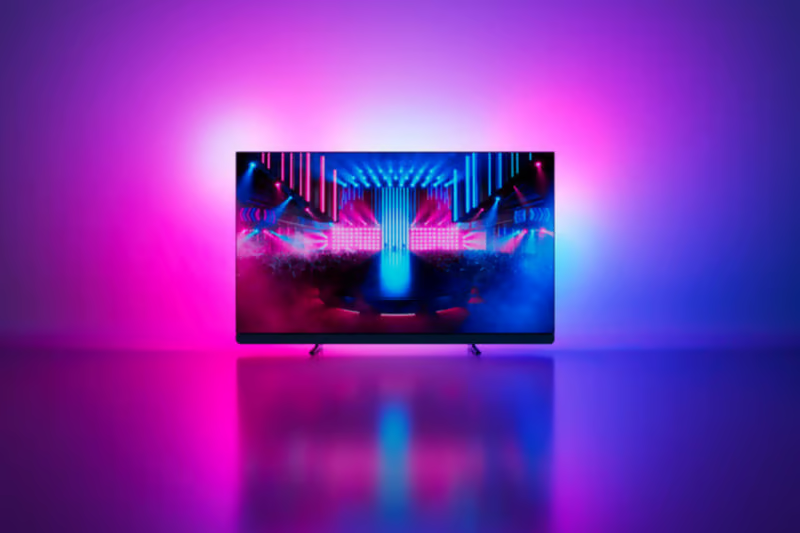
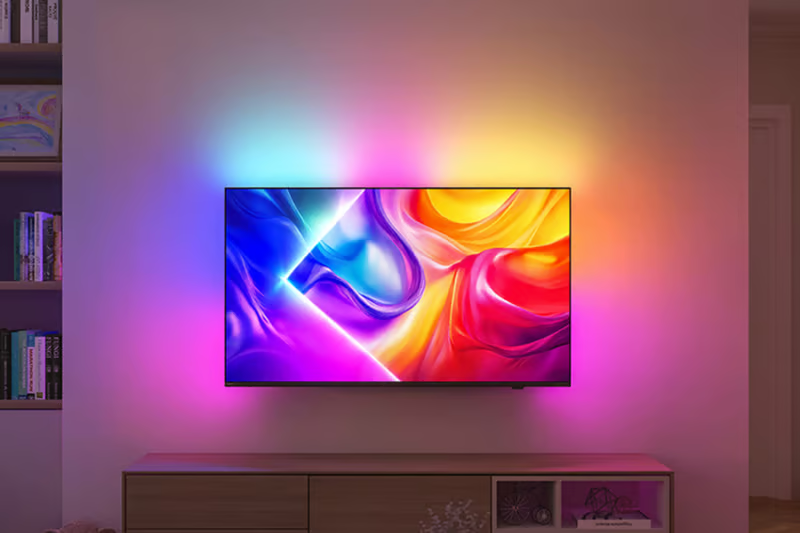
This is where Ambilight can make a real difference. Because the light responds to what is happening on screen, the picture feels less boxed in and more connected to the room. The effect is simple but noticeable: the image feels bigger, the room feels more involved, and the whole experience can seem closer to stepping up a size, in terms of perceived immersion, without changing the screen itself. There is a practical side to it too. In a dark room, many people find that soft light around the TV feels easier on the eyes than watching a bright screen against a black background.
So if you are choosing between two sizes, it is worth remembering that immersion is not only about inches. A better question can be not just “How big should I go?” but “How immersive do I want this to feel?”

Quick checklist before you buy
Before you make a final decision, run through these checks:
- Measure your viewing distance from where your head actually is when you sit or lie down, not from the edge of the furniture.
- Check the full dimensions of the TV, not just the screen size.
- Consider the position of your TV furniture or wall mount, including soundbar placement if you use one.
- Mark the outline on the wall with tape so you can judge the scale properly.
- Leave breathing room around the TV, especially if you want the setup to feel tidy and balanced. If you choose an Ambilight TV, a little wall space around it helps the effect stand out.
- Think about stand width, weight and wall strength if you are moving up to a larger model.
- Check power and cable access before mounting, so the final setup looks clean rather than improvised.
Common mistakes to avoid
A few mistakes can make a well-chosen TV feel less positive than it should:
- Choosing based only on diagonal size, not overall room scale.
- Mounting the TV too high, which can lead to neck strain over longer viewing sessions.
- Ignoring viewing distance and focusing only on what looks good in the showroom.
- Underestimating how quickly a larger screen starts to feel normal.
- Choosing the biggest size available without considering picture quality, brightness and room lighting
Frequently asked questions
How do I measure my TV size?
Measure the screen diagonally from one corner to the opposite corner. Do not include the frame.
What is the best TV size for a 3 metre viewing distance?
For a 3 metre viewing distance, 75 to 85 inches are often strong choices, depending on how immersive you want the experience to feel.
Can a TV be too big for a room?
Yes. If the screen dominates the room, sits too high or forces you to track the image too much with your eyes, it can feel tiring rather than immersive.
Is wall mounting better for larger TVs?
Often, yes. Wall mounting can make a bigger TV feel cleaner and less bulky in the room. Just make sure the mount supports the TV’s size, weight and VESA pattern, and plan cable access before installation.
Do all 55-inch TVs have the same width?
Not exactly. The screen size is standard, but bezels, frame shape and stand design can change the final dimensions slightly.
Should I always go one size bigger?
Not always. If the larger TV still suits your viewing distance, furniture and wall space, it is often the better long-term choice. But if it forces a bad layout or dominates the room, the smaller size may be the smarter buy.
Summary and next steps
The best TV size comes down to three things: your room, your viewing distance and the experience you want. Start by measuring where you sit, then choose a size that fits that distance and check the TV’s actual width and height, not just the diagonal figure. If you watch a lot of films, sport or games, it often makes sense to go slightly larger than you might initially expect, especially with 4K. And if you want a setup that feels more immersive without overwhelming the room, Ambilight can matter as much as the extra inches. When in doubt, do not focus on which TV looks biggest on paper. Focus on which one will feel right from the seat where you actually watch.
Want to dig deeper on specific sizes?
This article was created with the assistance of AI, along with detailed input, careful editing, and fact-checking by our team to ensure accuracy and quality.
Recommended products
- 65OLED801/12
- 164cm(65")AMBILIGHT TV
- 4K OLED. 120 Hz
- P5 AI perfect picture engine
- Dolby Vision and Dolby Atmos
- 65OLED911/12
- Ambilight TV, AmbiScape
- 4K OLED. Up to 165Hz
- Bowers & Wilkins sound
- P5 AI Intelligent Engine
- 85MLED910/12
- 215cm(85")AMBILIGHT TV
- 4K QD Mini-LED. VRR 144 Hz
- P5 Perfect Picture Engine
- Dolby Vision & Atmos


You might like

How to place your TV right in any room
Reading time: 12-14 min.

What makes a TV good for gaming?
Reading time: 6-8 min.

What is Titan OS?
Reading time: 4-6 min.

What is Ambilight TV? Why should you have one?
Reading time: 6-8 min.

What is Quantum Dot?
Reading time: 4-6 min.

What is a Smart TV? Key features explained
Reading time: 4-6 min.